

Artist
Luigi Miradori, known as “Il Genovesino”
Genoa, c. 1605 – Cremona, 1656
Works in the Collection
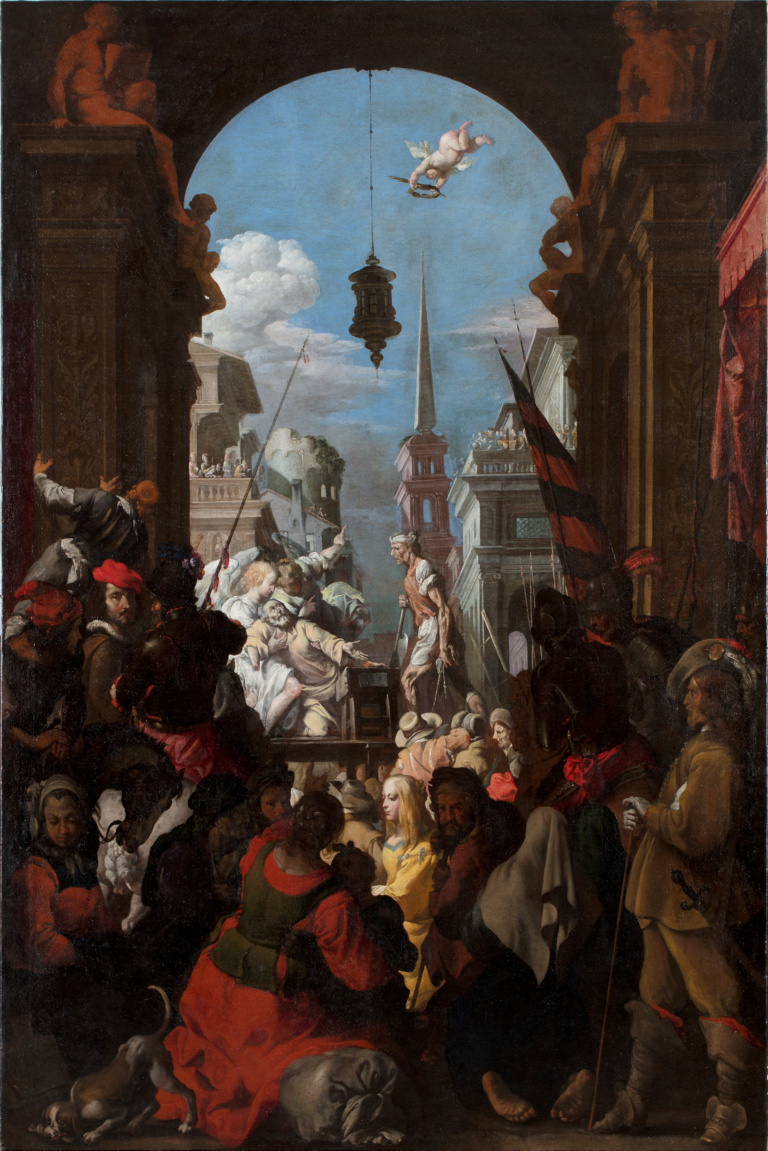
Luigi Miradori, known as Il Genovesino, was one of the leading figures on the art scene in 17th-century Cremona. Born in Genoa in the early years of the century, he trained in Liguria under the influence of Bernardo Strozzi and Giovanni Andrea De Ferrari. After a brief and unhappy experience in Piacenza, he settled permanently in Cremona in 1637, winning major religious and private commissions in the city. Under the protection of the Spanish Governor Don Álvaro de Quiñones, who appointed him court painter, Miradori consolidated his role as the pivotal artist in the city. His output stretched from altarpieces and moral allegories to portraits and genre pictures, in which he displayed astonishing versatility and a deep artistic sensitivity. An analysis of his life and career paints a picture of a polished, original artist well integrated into the social and cultural environment of his day and capable of reworking local and international influences in a highly innovative, personal style.
Luigi Miradori, known by the nickname of Il Genovesino1, is broadly acknowledged as the most important painter working in Cremona in the 17th century, despite the fact that his roots lay outside that city. As we can tell from the pseudonym by which he signed his work, “januensis”, Miradori proudly flaunted his Genoese origin. Born in Genoa, probably in the early years of the 17th century, he spent his childhood in that city and presumably also received his early training there, although it has not yet been possible to identify with any certainty either the master under whose guiding hand he trained or the workshop in which he received his training.
The first definite evidence of Miradori’s existence is dated 1627, the year in which he married Girolama Venerosi in Genoa. The couple had a daughter, Caterina, but she died at a very young age2. A few years later, in 1630, his name resurfaces in a tax record relating to taxation for the construction of the city walls3.
In order to reconstruct his formative years, we can turn to a limited number of paintings dating to his time in Genoa, the most important of which are St. Sebastian Tended by Irene in the Capuchin Friars’ convent of the Santissima Annunziata in Portoria, and the Lute Player now in the Palazzo Rosso in Genoa. Both paintings clearly point to Miradori’s proximity to two of Liguria’s leading artists, Bernardino Strozzi and Giovanni Andrea De Ferrari.
By the early 1630s, Miradori had settled in Piacenza. His presence in the city is recorded in September 1632, when his second child, Giacomo, was born there4. The reasons for his move are not totally clear, however. He may have been following a trend set by the many Genoese seeking fresh opportunities elsewhere after the plague epidemic of 1631 came to an end. Another (possibly more plausible) hypothesis is that he was influenced by a Genoese merchant, poet and man of letters named Bernardo Morando, who had been appointed while still a young man to run the Piacenza branch of his family’s business. A man of polish and influence, he is one of Miradori’s first recorded patrons5. The time Miradori spent in Piacenza was marked by unhappy events. He lost his daughter Angela Nicoletta in 1634 and his son Giovanni Battista the following year, both within days of their birth, and they were followed to the grave by his wife Girolama in 1635. Yet despite the tragic moment, he married again the same year, taking for wife Anna Maria Ferrari, who was also of Genoese origin6.
Miradori’s time in Piacenza proved to be disappointing also from a professional point of view, because he never managed to win any important commissions, and so in 1635, barely three years after settling in the city, he was forced to turn directly to the Duchess of Parma and Piacenza, Margherita de’ Medici, with a plea for permission to leave Farnese territory in order to “go elsewhere to seek his fortune”7. We do not know whether that permission was officially granted, but he is likely to have left Piacenza shortly afterwards, because his presence at the baptism of his daughter Felice Antonia in Cremona is recorded in January 1637. Two years later, in December 1639, he bought a house in the San Clemente in Gonzaga neighbourhood, not far from the Cathedral, a move that marked the stable beginning of his activity in the city8.
His move to Cremona may, once again, have been prompted by the influence of Bernardo Morando, who had solid business ties in the city, but we cannot rule out another potential reason: Cremona already hosted a fairly substantial Genoese community in the early years of the 17th century, and that community may well have included one or more relatives of Miradori9.
Miradori had begun to make himself known in Cremona even before 1639 thanks to a number of major commissions, suggesting that his work enjoyed a favourable reception in local circles. The year 1644, however, was to mark a turning point in his career. Don Álvaro de Quiñones, who had been appointed governor and castellan of the city in 1639, arrived in Cremona and selected Miradori as his painter of choice. In addition to commissioning numerous paintings from him and to involving him in the decoration of the Castello di Santa Croce, Quiñones gave him a fixed salary and even a coach with a footman, all tangible pointers to the prestigious position that the artist had now achieved.
From the mid-1640s onwards, Miradori’s career went from strength to strength. The backing of Don Álvaro de Quiñones and painter Pietro Martire Neri’s departure from Cremona helped to consolidate his position and he rapidly achieved fame and recognition in local society.
In fact, his fame reached such a peak that in 1651 a Cremonese composer by the name of Tarquinio Merola dedicated an instrumental composition to him, entitled La Miradoro, in his fourth book of songs10.
The period stretching from 1644 to 1650 was particularly fruitful for Miradori, who received numerous commissions in those years both in Cremona and in other parts of Lombardy. Between 1644 and 1646, he worked on the decoration of the new altar of St. Roch in Cremona Cathedral, an important commission that testifies to the artist’s now consolidated prestige in the city.
In 1646, he also painted a Madonna and Child with St. Joseph, St. Apollonia, St. Charles, St. Roch and St. Sebastian for the parish church of Castello Cabiaglio in the province of Varese, and he completed a St. Jerome in His Study for the church of San Martino in Treviglio, a painting commissioned by Giacomo Serra, the municipal representative at the Camera Cesarea in Milan.
Another painting that can be dated to 1646 is his Portrait of Sigismondo Ponzone Aged Four, now in the Museo Civico in Cremona. Commissioned by the sitter’s father, Count Nicolò Ponzone, this picture is one of the rare but significant examples of Miradori’s portraiture. Ponzone also commissioned him to produce a series of small pictures on various themes, ranging from genre scenes to historical and mythological subjects, moral allegories and paintings of a devotional nature.
And finally, of particular importance is a large canvas depicting Zenobia, Queen of Palmyra, commissioned by Don Álvaro de Quiñones and now in a private collection. The painting portrays the legendary queen as a symbol of female strength and virtue, drawing its inspiration from an early play by Pedro Calderón de la Barca11.
One of the most frequent and popular subjects in Miradori’s output was that of Vanitas, which he tackled in a number of different variants, revealing an astonishing ability to renew a subject already abundantly revisited in the 17th century. One of the most significant variants is a picture now in the Museo Civico in Cremona, but many of them now in private collections testify to the popularity and the iconographical success of the subject in his repertoire12.
In 1647, Miradori received the most prestigious public commission of his entire career in Cremona, a large Multiplication of the Loaves and the Fishes, now on display in the town hall but originally painted for the chancel of the church of San Francesco. This monumental painting13 was commissioned by Father Vincenzo Balconi, according to a plaque hanging from the tree on the left of the scene.
1648 was a particularly trying year for Cremona. After the defeat of the Spanish troops, the city was besieged by French forces allied with the Duchies of Modena and Savoy. Though the attack was eventually repulsed, it had taken its toll of the local population, which was exhausted, and had a serious impact on the local economy. Yet despite these tragic circumstances, Miradori pursued his career without a break. That same year, he completed a Miracle of St. John Damascene for the church of San Clemente (later Santa Maria Maddalena) and he painted an (unfortunately, now lost) Imaginary View of the Port of Genoa with the Fall of Icarus for his influential protector, Don Álvaro de Quiñones.
1651 was to prove a very demanding year for Miradori on the artistic front, with two major religious paintings dating to this period: a Rest on the Flight into Egypt, which he painted for the Descalced Carmelites of Sant’Imerio, and an altarpiece depicting the Apparition of the Virgin to the Blessed Felice da Cantalice, now in the Musée National du Château di Compiègne (on permanent loan from the Louvre) and mentioned by Béguin in 1960.
Work continued to flow in without a break in the early 1650s. In December 1653, the sources inform us that Miradori received payment for a Last Supper for the Confraternity of the Most Blessed Sacrament in the church of San Siro in Soresina14. The following year, in 1654, he completed an Annunciation, signed and dated, for the church of Santa Maria dei Sabbioni at Cappella Cantone, and a St. Lucy for the church of Santi Faustino e Giovita in Castelponzone. This latter painting, which was probably commissioned by the lords of the manor, the Ponzone family, was part of a consolidated pattern of patronage, if we consider that the family owned a fair number of works by Miradori15.
Also in 1654, he painted a St. Nicholas of Bari with Donor now in the Pinacoteca di Brera in Milan, but originally made for the church of San Vincenzo in Cremona. The figure kneeling beside the saint has been identified as Martino Rota, who also appears in Miradori’s family documents as the godfather of Raffaele Nicola, one of the painter’s sons16.
In the meantime, Miradori continued to cultivate his professional relationship with the castellan, Don Álvaro de Quiñones. The inventory draughted on the Spanish nobleman’s death in 1657 confirms the presence of several pictures by Miradori in his private collection, including four panels depicting Stories from the Life of Samson and four others depicting the Labours of Hercules, all sadly now lost. The latter four may well be part of eleven “small pictures with the efforts of Hercules” mentioned in the sources of the time17, testifying to Quiñones’ interest in allegorical and moral themes of heroic inspiration.
Miradori’s growing integration into the civic and religious life of Cremona is confirmed by the role that he played in the Confraternity of the Most Blessed Sacrament attached to the church of San Clemente. He was elected Prior of the Confraternity in 1654 and again in 1655.
Miradori’s election marked the peak of his social ascent, crowning a career that had taken him from Genoa to the very top of Cremona society. Yet he was only able to enjoy that recognition for a short time. He draughted his will on 21 February 1656, naming his children Giacomo, Felice Antonia, Elisabetta and Antonio Francesco as his heirs18, and he must have died shortly afterwards. The last document recording his activity is a bill of payment dated 24 May 1656, in which the Confraternity of the Most Blessed Sacrament of Soresina paid him for four Evangelists intended to complete the decoration of his now lost Last Supper19.
- For a detailed, up-to-date biography of Il Genovesino, see A. Serafini, La vita del Genovesino, in Genovesino. Natura e invenzione nella pittura del Seicento a Cremona, exhibition catalogue (Cremona, Museo Civico “Ala Ponzone”) ed. F. Frangi, V. Guazzoni and M. Tanzi, Milan 2017, pp. 204-206. See this catalogue and L. Bellingeri’s monographic work, Genovesino, Galatina 2007, also for all the paintings mentioned here, unless otherwise specified.
- L. Bellingeri, Genovesino a Cremona, in Di musica e arte, di peste e guerre. Il Seicento a Cremona al tempo del Genovesino, exhibition catalogue (Cremona) ed. A. Mazzucchi and F. Bottini, Roccafranca, Brescia 2009, p. 11.
- L. Alfonso, Liguri illustri: Castellino Castello, in “La Berio”, XV, 2, 1975, p. 48; C. Gallamini, Ricchi e poveri del pennello nella mappa fiscale del 1630, in “La Casana”, 51, 2009, pp. 10-13.
- G. Fiori, Notizie biografiche di pittori piacentini dal ’500 al ’700, in “Archivio storico per le province parmensi”, XXII, 1970, pp. 75-116.
- M. Tanzi, La Zenobia di don Álvaro, Cremona 2009, pp. 24-25.
- Bellingeri 2007, op. cit. (note 1), p. 67.
- M. Tanzi, Genovesino a Castelponzone, in “Ricerche di Storia dell’Arte”, 38, 1989, pp. 91-92.
- L. Bellingeri, Genovesino rivelato. Un pittore, un committente, un enigma, in “Brera mai vista”, 10, ed. V. Maderna and C. Quattrini, Milan 2004, p. 41.
- M. Tanzi, La Zenobia di don Álvaro e altri studi sul Seicento tra la Bassa padana e l’Europa, Milan 2015, pp. 115, 189-190.
- Ibid., pp. 114–115.
- Ibid., pp. 105–116.
- Ibid., pp. 184–190, cat. nos. 32, 33.
- 477 × 764 cm.
- V. Guazzoni, Dall’Olivieri al Diotti. Tre secoli di vicende artistiche, in Soresina. Dalle origini al tramonto dell’Ancien Régime, ed. R. Cabrini and V. Guazzoni, Soresina 1992, pp. 423-424.
- G. Toninelli, I conti Ponzoni e la loro collezione d’arte, in La Pinacoteca. Origine e Collezioni, ed. V.Guazzoni, Cremona 1997, pp. 47-54.
- Bellingeri 2004, op. cit. (note 8).
- Bellingeri 2007, op. cit. (note 1), pp. 10, 27.
- Ibid, pp. 12, 69–70.
- Guazzoni 1992, op. cit. (note 14), pp. 394, 423.
Scholars &
Contributors
How to cite:
T. Borgogelli, Luigi Miradori, known as “Il Genovesino”, in Gaudium Magnum Foundation. The Painting Collection, ed. V. Rossi, with T. Borgogelli and A. Marengo, Lisbon 2026.
Are you a scholar, institution, or cultural organisation interested in our Collection?
Our team welcomes enquiries about loans, reproduction rights, conservation records, and research access.

Still-Life with a Dish of Peaches and Grapes
Louyse Moillon
c. 1630

Allegorical Tomb of King William III of Great Britain
Antonio Balestra, Giovan Battista Cimaroli, Domenico and Giuseppe Valeriani
c. 1722-26

Vanitas: An Old Man and a Young Lute Player
Jacques des Rousseaux
1631

St. John the Baptist
Giovanni Baglione
1610